A few weeks ago a local Pastor (here in Clearwater, FL) made the following comment to his congregation during a Sunday morning worship service: “The ministry is the only profession where we send our brightest young men and women off to study at the Masters and Doctorial level, and when they come back to us we don’t allow them to tell us what they learned.”
Most of you—I believe—will understand what the good Pastor was inferring. For those who may be puzzled by the Pastors comment, let me explain; The Christian doctrine seminary students learn is NOT the Christian doctrine that you and I have been taught since childhood. The doctrine taught in most seminaries today is an academic understanding of the Christian religion that has developed over the past 250-300 years. It reflects our current knowledge of the cosmos, the human mind and the natural laws of the world in which we live. In my book, GIVING VOICE TO THE SILENT PULPIT, I refer to this as Academic Christianity. In many ways it is diametrically opposed to the doctrine you and I were taught as children and what we hear on a weekly basis from the pulpit of our local church. This I refer to as Popular Christianity.
The differences between these two adaptations of the Christian faith are so divergent that a young Pastor, fresh out of seminary, would likely never reveal his/her new knowledge to a pastoral search committee for fear of being immediately rejected for any potential ministerial position. Why? Because most Christians—the people in the pews—expect to hear nothing from the pulpit but the doctrine they grew up with. The same doctrine our forefathers (and foremothers) believed and taught them in their younger years. They are devoted to those basic ancient beliefs. They have invested too much of their mental security in those values to allow new knowledge to invade their ‘cocoon of religious comfort.’
And so . . . our newly educated Pastor, in order to secure a job, must acquiesce to the presumed desires of the multitudes and preach only the ancient, outdated, obsolete and basically irrelevant Popular doctrine of the past.
The victims in this charade: -
· The people in the pews—who are denied an intellectually honest understanding of their faith.
· The Pastors—who must, daily, perjure themselves in pastoral contact with their parishioners.
· Society at large—which is deprived of intellectual growth and maturity.
The winners: -
· Those who would use religion to impose their particular brand of social ethics on others.
· Those, around the world who, today, use the ‘word’ or ‘will’ of God to terrorize, murder and oppress others in the name of religion.
If the church is to survive this duality in doctrine, honesty must prevail.
Learn more about this struggle between Popular and Academic Christianity (including ten side-by-side examples) in my new book—GIVING VOICE TO THE SILENT PULPIT.
More information at http://www.barryblood.com/
Shalom,
Barry e
Monday, November 21, 2011

Tuesday, May 17, 2011
Giving Voice to the Silent Pulpit
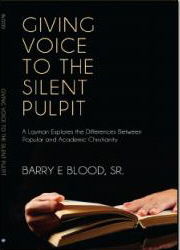 I was not a religious fanatic by any means, but the church and all that it represented, was very important to me in my formative years—as it was, I believe, for most young people of that era. As I grew into adulthood, I began to take on, what I considered to be, my share of responsibilities in the church. I served as an usher, sang in the choir, and served on various boards and committees. At one point I became trained as a Lay Minister and served as a substitute preacher from time to time. I guess I would be called an active Christian.
However, in 1993, at age fifty-eight, my understanding of the Christian belief system began to change. This change was prompted by a life altering experience, which is reveled in chapter 1 of this book. The change was not something that happened overnight; rather, it took several years of study and investigation. Years during which I found myself hoping I was wrong about what I was discovering. But in the end I realized I was not wrong. Today I am still a Christian, but a Christian with a much deeper and more honest and mature understanding of what Christianity is about. A great deal of what I mean by “a much more honest and mature understanding “ will be dealt with, in detail, in the book.
I anticipate that this book will, to a degree, cause you, the reader, some of the same pain and stress that I felt in the early stages of my investigation and discovery. Do not despair. In the end, I am convinced you will become aware of a much richer and far more rewarding understanding of the Christian faith, than you have ever before experienced.
In my opinion, if the Christian church is to live on, as a force for good in human society, the greater depth of knowledge that is exposed herein, will of necessity, become the norm in Christian education among the laity.
Please remember as you read . . . this is not a book in which I make known my opinion on religious teachings. Rather it is a book in which I report, with straightforward honesty, information about Christianity and Christian doctrine that is unknown to a vast majority of the laymen and laywomen of the faith.
I will be reporting the results of many years of study. Some of my findings will certainly invade the reader’s comfort zone. For this, I make no apology. Knowledge can sometimes be painful, but ignorance also has a price. I will not maliciously tear down sacred beliefs. I will merely report what the past two and one half centuries of Biblical scholarship has reveled and how it has changed the church’s understanding of Christian doctrine.
The church has a responsibility to keep the laity informed of new knowledge, but has chosen not to do so. Instead, the church has, more often than not, chosen to deny, rebuff, or simply remain silent about new knowledge that would counter ancient beliefs. Today the gap between what is preached from the pulpit and what the clergy and hierarchy of the church know has become problematical.
This problem can only be solved by exposing the church’s hidden secrets. To my way of thinking, there is no choice—the church must turn to a more honest doctrine or perish. Perhaps together you and I can start to solve this problem. This book is my attempt to get that ball rolling.
More information at, http://barryblood.com/
Available from publisher: Wipf and Stock, Eugene, OR
barry e
Tuesday, March 1, 2011
Why We Believe
I have just finished the book SUPERSENSE - Why We Believe in the Unbelievable by Bruce M. Hood. Thought you might enjoy the following excerpt regarding belief in the supernatural . . .
Psychologists have come to the conclusion that there are at least two different systems operating when it comes to thinking and reasoning. One system is believed to be evolutionarily more ancient in terms of human development; it has been called intuitive, natural, automatic, heuristic, and implicit. It is the system we think is operating in young children before they reach school age. The second system is one that is believed to be more recent in human evolution; it permits logical reasoning but is limited by executive functions . . . This second reasoning system has been called conceptual-logical, analytical-rational, deliberative-effortful-intentional-systematic, and explicit. It emerges much later in development and underpins the capacity of the child to perform logical, rational problem-solving. When we reason about the world using these two systems, they may sometimes work in competition with each other.
One might assume that those prone to the supersense and belief in the paranormal (or supernatural) are lacking in rational thought processes, but that would be too simplistic. Studies reveal that the two systems of thinking, the intuitive and the rational, coexist in the same individuals. There are, in effect, two different ways of interpreting the world. In fact, when we measure reliance on intuition, no relationship has been found with intelligence. Intuitive people are not more stupid. They are, however, more prone to supernatural belief . . . The supersense lingers in the back of our minds, influencing our behaviors and thoughts, and our mood may play a triggering role. This explains why perfectly rational, highly educated individuals can still hold supernatural beliefs.
barry e
Psychologists have come to the conclusion that there are at least two different systems operating when it comes to thinking and reasoning. One system is believed to be evolutionarily more ancient in terms of human development; it has been called intuitive, natural, automatic, heuristic, and implicit. It is the system we think is operating in young children before they reach school age. The second system is one that is believed to be more recent in human evolution; it permits logical reasoning but is limited by executive functions . . . This second reasoning system has been called conceptual-logical, analytical-rational, deliberative-effortful-intentional-systematic, and explicit. It emerges much later in development and underpins the capacity of the child to perform logical, rational problem-solving. When we reason about the world using these two systems, they may sometimes work in competition with each other.
One might assume that those prone to the supersense and belief in the paranormal (or supernatural) are lacking in rational thought processes, but that would be too simplistic. Studies reveal that the two systems of thinking, the intuitive and the rational, coexist in the same individuals. There are, in effect, two different ways of interpreting the world. In fact, when we measure reliance on intuition, no relationship has been found with intelligence. Intuitive people are not more stupid. They are, however, more prone to supernatural belief . . . The supersense lingers in the back of our minds, influencing our behaviors and thoughts, and our mood may play a triggering role. This explains why perfectly rational, highly educated individuals can still hold supernatural beliefs.
barry e
Wednesday, November 24, 2010
A Special Report...
This past Sunday Chris and I attended worship service at, Pilgrims in the Park in Bryan, TX.
Pilgrims in the Park is an open air church service conducted, administered and financed by the seventy year young Rev. Lenni Lissberger, for "all wayfarers on life's journey". Services are held under a picnic shelter each Sunday in Neal Park, a small public park on the west side of Byran, TX.
Rev. Lenni prepares lunch for her parishioners every week. This week she brought sandwiches, boiled eggs. cookies, coffee and orange juice. She pays for the food and supplies out of her own pocket. The parishioners are very grateful.
There were roughly thirty people in attendance this Sunday. All but four or five were homeless folks.
On the front of the worship bulletin - which Rev. Linne also prepares and prints each week - are there words...
Pilgrims in the Park is an open air church service conducted, administered and financed by the seventy year young Rev. Lenni Lissberger, for "all wayfarers on life's journey". Services are held under a picnic shelter each Sunday in Neal Park, a small public park on the west side of Byran, TX.
Rev. Lenni prepares lunch for her parishioners every week. This week she brought sandwiches, boiled eggs. cookies, coffee and orange juice. She pays for the food and supplies out of her own pocket. The parishioners are very grateful.
There were roughly thirty people in attendance this Sunday. All but four or five were homeless folks.
On the front of the worship bulletin - which Rev. Linne also prepares and prints each week - are there words...
Regardless how much money you have in your pocket,
Regardless of where you spent the night,
Regardless what language you speak,
Regardless of the color of your skin,
Regardless of who you love,
Regardless of whether
you have a family,
or we become
your family,
You are welcome here!
.
There was hymn singing and praying. There was a time for greeting each other and a time for scripture reading. Rev. Lenni gave a short inspirational talk. Several of the congregants helped in the service. One read the scripture, another handed out bulletins, several participated by expressing their sorrows and thanksgivings during the community prayer. Most all were homeless, down on their luck and destitute, but one could sense that they really cared about each other's welfare.
.
After the service, several people, without being ask, packed up the coffee jugs and other things, folded the table and loaded everything neatly in the back of Rev. Lenni's car. Next week when she arrives there will be several there to help unload and set everything up again.
.
I don't know that I have ever witnessed more honest and selfless expressions of the teachings of Jesus - to love one another, to show compassion, to include those on the margins of society - than I did that morning. The people who attend worship service at Pilgrims in the Park are very special people... And the Rev. Lenni Lissberger, who makes it happen, week after week, is a very special human being.
.
Shalom,
barry e
Tuesday, June 29, 2010
The move from Polytheism to Monotheism
In all my studies of religion I had never thought to ask the question, “What motivated humans to move from polytheism to monotheism.” The question and the answer came to me while reading Robert Wright’s book, The Evolution of God, (Little, Brown and Company, 2009). Five hundred sixty seven pages crammed full of interesting information, much of which I have read in other sources, but the section regarding the move from ‘poly’ to ‘mono’ was so new and informative, I thought I would share it with you. So, here it is in short, capsule form…
When King Hammurabi came to power in Babylon, near the beginning of the second millennium BCE, all of Mesopotamia was polytheistic. There were dozens of gods worshiped throughout the country. Hammurabi’s base was Babylon and the god of Babylon was Marduk.
Hammurabi had aspirations of ruling all of Mesopotamia, but he died before that could happen. In the ensuing centuries, however, Babylon did rule all of Mesopotamia and Marduk eventually became the head of the Mesopotamian pantheon.
In a move of major theological development, the champions of Marduk began to demote the other gods of the pantheon from being Murduk’s subordinates to being mere aspects of him. i.e. Adad, once known as the god of rain was now, “Murduk of rain.” Nabu, the god of accounting became, “Marduk of accounting.”
Among other things, there was a very practical political reason for this move. Each of the gods of the pantheon wielded a certain amount of political power. Each had priests, temples and followers. By consolidating the powers of these lesser gods into Marduk’s realm, the political power of would be opposition was nullified. Wright states it like this; “For Babylonians who wanted to suffuse all of Mesopotamia in multicultural amity and understanding, what better social cement than a single god that encompasses all gods?”
Later, in the fourteenth century BCE an eccentric pharaoh known as Amenhotep IV came to power in Egypt. This new young pharaoh was quite ambitious and eager to seize control. He elevated his favorite god, Aten, from being a garden-variety deity to “he who decrees life”; he who “created the earth”; he who “built himself by himself.”
But Amenhotep IV was not interested in the slow absorption of other gods into his god Aten, as had taken place with Marduk. Instead he had the names and the temples of all other gods erased from the face of the earth and their priesthoods dissolved. Aten stood alone at the top of the heap in a monotheistic fashion. But Aten eventually fell from grace and was replaced by other gods and other pharaohs.
Some claim that Aten nonetheless changed the world forever. Sigmund Freud, in his book Moses and Monotheism, suggests that Moses was in Egypt during Aten’s reign and then carried this idea of monotheism to Canaan, where it would launch Judeo-Christian civilization.
While most Jews and Christians think of the Torah and the Bible as referring to a single God, close study shows that the early Israelites worshipped many gods. The Israelites were polytheistic, just as most of the rest of the world at that time. There are many references to this fact in the Bible. Wright does a masterful job of explaining this and how the Kings of the day used the movement from ‘poly’ to ‘mono’ in much the same way as Amenhotep IV did, to attempt to expand their power.
...Toward the end of the seventh dentury BCE, this opportunity was seized by the most important king in the theological history of Israel… His name was Josiah and he assumed the throne around 640 BCE. … Josiah wasn’t adverse to a little thuggery... For starters, Josiah had priests take from Yahweh’s temple and burn “all the vessels made for Baal, for Asherah” and for “all the hosts of heaven” (which in this case means defied celestial bodies). He removed horses used is sun worship form the entrance to the temple and “burned the chariots of the sun with fire.” He wiped out the shrines built for “Astarte the abomination of the Sidonians, for Chemosh the abonination of the Moab, and for Milcom the abomination of the Ammonites” – and, as a kind of exclamation point, covered these sites with human bones. Josiah also banned mediums, sorcerers, household gods, idols, and miscellaneous other “abominations that were seen in the land of Judah and in Jerusalem.”(2 Kings 23:5,20)
He tore down all the “high places” or alters across Judah where other gods were worshiped. But the alters were not his only target. He “deposed” the priests associated with these gods, including those who “made offerings to Baal, to the sun, the moon, and the constellations.” In the former northern kingdom he “slaughtered on the alters all the priests of the high places who were there, and burned human bones on them. Then he returned to Jerusalem.” This presumably made for a more powerful Jerusalem, for all sources of divine authority and political power were now gone. Josiah had ‘centralized the cult,” as scholars but it.
This move from ‘poly’ to ‘mono’ seemed to have stuck for what would later become the three Abrahamic religions. Josiah seems to be the person in history who was most instrumental in making that happen (brutal but effective). Was his motive religious or politics? Hum!
Interesting...
barry e
When King Hammurabi came to power in Babylon, near the beginning of the second millennium BCE, all of Mesopotamia was polytheistic. There were dozens of gods worshiped throughout the country. Hammurabi’s base was Babylon and the god of Babylon was Marduk.
Hammurabi had aspirations of ruling all of Mesopotamia, but he died before that could happen. In the ensuing centuries, however, Babylon did rule all of Mesopotamia and Marduk eventually became the head of the Mesopotamian pantheon.
In a move of major theological development, the champions of Marduk began to demote the other gods of the pantheon from being Murduk’s subordinates to being mere aspects of him. i.e. Adad, once known as the god of rain was now, “Murduk of rain.” Nabu, the god of accounting became, “Marduk of accounting.”
Among other things, there was a very practical political reason for this move. Each of the gods of the pantheon wielded a certain amount of political power. Each had priests, temples and followers. By consolidating the powers of these lesser gods into Marduk’s realm, the political power of would be opposition was nullified. Wright states it like this; “For Babylonians who wanted to suffuse all of Mesopotamia in multicultural amity and understanding, what better social cement than a single god that encompasses all gods?”
Later, in the fourteenth century BCE an eccentric pharaoh known as Amenhotep IV came to power in Egypt. This new young pharaoh was quite ambitious and eager to seize control. He elevated his favorite god, Aten, from being a garden-variety deity to “he who decrees life”; he who “created the earth”; he who “built himself by himself.”
But Amenhotep IV was not interested in the slow absorption of other gods into his god Aten, as had taken place with Marduk. Instead he had the names and the temples of all other gods erased from the face of the earth and their priesthoods dissolved. Aten stood alone at the top of the heap in a monotheistic fashion. But Aten eventually fell from grace and was replaced by other gods and other pharaohs.
Some claim that Aten nonetheless changed the world forever. Sigmund Freud, in his book Moses and Monotheism, suggests that Moses was in Egypt during Aten’s reign and then carried this idea of monotheism to Canaan, where it would launch Judeo-Christian civilization.
While most Jews and Christians think of the Torah and the Bible as referring to a single God, close study shows that the early Israelites worshipped many gods. The Israelites were polytheistic, just as most of the rest of the world at that time. There are many references to this fact in the Bible. Wright does a masterful job of explaining this and how the Kings of the day used the movement from ‘poly’ to ‘mono’ in much the same way as Amenhotep IV did, to attempt to expand their power.
...Toward the end of the seventh dentury BCE, this opportunity was seized by the most important king in the theological history of Israel… His name was Josiah and he assumed the throne around 640 BCE. … Josiah wasn’t adverse to a little thuggery... For starters, Josiah had priests take from Yahweh’s temple and burn “all the vessels made for Baal, for Asherah” and for “all the hosts of heaven” (which in this case means defied celestial bodies). He removed horses used is sun worship form the entrance to the temple and “burned the chariots of the sun with fire.” He wiped out the shrines built for “Astarte the abomination of the Sidonians, for Chemosh the abonination of the Moab, and for Milcom the abomination of the Ammonites” – and, as a kind of exclamation point, covered these sites with human bones. Josiah also banned mediums, sorcerers, household gods, idols, and miscellaneous other “abominations that were seen in the land of Judah and in Jerusalem.”(2 Kings 23:5,20)
He tore down all the “high places” or alters across Judah where other gods were worshiped. But the alters were not his only target. He “deposed” the priests associated with these gods, including those who “made offerings to Baal, to the sun, the moon, and the constellations.” In the former northern kingdom he “slaughtered on the alters all the priests of the high places who were there, and burned human bones on them. Then he returned to Jerusalem.” This presumably made for a more powerful Jerusalem, for all sources of divine authority and political power were now gone. Josiah had ‘centralized the cult,” as scholars but it.
This move from ‘poly’ to ‘mono’ seemed to have stuck for what would later become the three Abrahamic religions. Josiah seems to be the person in history who was most instrumental in making that happen (brutal but effective). Was his motive religious or politics? Hum!
Interesting...
barry e
Tuesday, May 11, 2010
From: Sigmund Freud (1932) - A Philosophy of Life
While the different religions wrangle with one another as to which of them is in possession of the truth, in our view the truth of religion may be altogether disregarded.
 Religion is an attempt to get control over the sensory world, in which we are placed, by means of the wish-world, which we have developed inside us as a result of biological and psychological necessities. But it cannot achieve its end. Its doctrines carry with them the stamp of the times in which they originated, the ignorant childhood days of the human race.
Its consolations deserve no trust. Experience teaches us that the world is not a nursery. The ethical commands, to which religion seeks to lend its weight, require some other foundation instead, for human society cannot do without them, and it is dangerous to link up obedience to them with religious belief.
If one attempts to assign to religion its place in man’s evolution, it seems not so much to be a lasting acquisition as a parallel to the neurosis which the civilized individual must pass through on his way from childhood to maturity.
Sigmund Freud
Shalom,
barrye
 Religion is an attempt to get control over the sensory world, in which we are placed, by means of the wish-world, which we have developed inside us as a result of biological and psychological necessities. But it cannot achieve its end. Its doctrines carry with them the stamp of the times in which they originated, the ignorant childhood days of the human race.
Its consolations deserve no trust. Experience teaches us that the world is not a nursery. The ethical commands, to which religion seeks to lend its weight, require some other foundation instead, for human society cannot do without them, and it is dangerous to link up obedience to them with religious belief.
If one attempts to assign to religion its place in man’s evolution, it seems not so much to be a lasting acquisition as a parallel to the neurosis which the civilized individual must pass through on his way from childhood to maturity.
Sigmund Freud
Shalom,
barrye
Wednesday, March 10, 2010
The Invisible Velvet Curtain (it actually exists)
The Rev. Father Donald Cupitt, Anglican priest and Christian author, calls it a painted veil….I have often called it an Invisible Velvet Curtain that hangs between the pulpit and the pews of most all Christian churches.
An Invisible Velvet Curtain that separates ‘Popular Christianity’…. (the domain of the people-in-the-pews), from ‘Academic Christianity’…. (which is the domain of the church hierarchy from the pulpit to the Pope)
For the past six years, the Delphi Study Group (a.k.a. the Sojourners class) has been studying this Academic understanding of Christianity. We have been studying what students are taught in seminaries and religion classes in colleges and universities around the world.
Our studies have brought us in contact with many of today’s church leaders, historians, pastors, bishops, professors, biblical scholars and theologians. We have studied their writings, …listened to their lectures both in person and on the computer. …. We even took a semester of classes on the Old Testament from Yale University, via the internet.
We have come to appreciate many of the differences between these two understandings of Christianity. Some of these differences are somewhat shocking, some even traumatic…. But all of them are interesting.
We have discovered that these two belief systems (Popular vs. Professional or Academic) are so different in their respective views of Christian doctrine that if stripped of their Christian identity, and viewed separately,… most people would not recognize them as elements of the same religion.
Yet we have also discovered that while there are many differences between Popular and Academic Christianity, one point remains the same…. The teachings of Jesus of Nazareth….. to love one another, to care for the disadvantaged, to seek justice for all people.
The Church as a whole is moving toward a fuller understanding of Academic Christianity…More and more Christians are beginning to see over, under and around the Invisible Velvet Curtain…its a long slow process… but as it happens, the teachings of Jesus…. (as opposed to the teachings about Jesus)…. will become more and more the center of our faith journey.
barry e
An Invisible Velvet Curtain that separates ‘Popular Christianity’…. (the domain of the people-in-the-pews), from ‘Academic Christianity’…. (which is the domain of the church hierarchy from the pulpit to the Pope)
For the past six years, the Delphi Study Group (a.k.a. the Sojourners class) has been studying this Academic understanding of Christianity. We have been studying what students are taught in seminaries and religion classes in colleges and universities around the world.
Our studies have brought us in contact with many of today’s church leaders, historians, pastors, bishops, professors, biblical scholars and theologians. We have studied their writings, …listened to their lectures both in person and on the computer. …. We even took a semester of classes on the Old Testament from Yale University, via the internet.
We have come to appreciate many of the differences between these two understandings of Christianity. Some of these differences are somewhat shocking, some even traumatic…. But all of them are interesting.
We have discovered that these two belief systems (Popular vs. Professional or Academic) are so different in their respective views of Christian doctrine that if stripped of their Christian identity, and viewed separately,… most people would not recognize them as elements of the same religion.
Yet we have also discovered that while there are many differences between Popular and Academic Christianity, one point remains the same…. The teachings of Jesus of Nazareth….. to love one another, to care for the disadvantaged, to seek justice for all people.
The Church as a whole is moving toward a fuller understanding of Academic Christianity…More and more Christians are beginning to see over, under and around the Invisible Velvet Curtain…its a long slow process… but as it happens, the teachings of Jesus…. (as opposed to the teachings about Jesus)…. will become more and more the center of our faith journey.
barry e
Friday, January 8, 2010
Everything changes
Actress Marlene Dietrich was a popular film star in the 1930’s 40’s and 50’s. She made a movie in 1936 called The Garden of Allah. She had a favorite cameraman on the movie set that (she thought) seemed to take all her shots with just the right lighting, just the right angles to bring out her best features.
Some twenty years later on yet another movie set, she came across that same cameraman and insisted that the director allow him do all the film shots of her.
One aft ernoon after viewing the film of that day’s shooting, Ms Dietrich confided in the cameraman, “I don’t know,” she said, “they just don’t seem the same as they did before, they look different for some reason.”
To wit: the cameraman replied, quite discreetly… “Well you know Marlene darling, my camera is twenty years older..”
Whether the difference was the age of the camera or the age of the actress is immaterial… the point here is that everything changes over time.
If things did not change, we might still be communicating with our friends and relatives up North by use of the ‘pony express.’
If things did not change, we might exit our local mall some morning to find a parking lot full of horses and buggies…and perhaps an ample supply of fertilizer for our rose gardens.
Everything changes over time… even religion. If religion did not change over time, we might still be sacrificing our first born children to the gods on a blood soaked alter.
If religion did not change we might still believe that God resided just a few hundred feet up in the air, just beyond the blue canopy that hangs over the earth.
Even our concept of who or what god is… changes over time.
3500 years ago people believed in many gods, even a few goddesses as well… Each god or goddess had control over a particular element of nature.
3000 years ago the world went through what is called the First Axial Period, where some, perhaps most, religions began to combine the powers of all their gods and goddesses into one supreme God. This change, even in the relatively small Hebrew nation, took several hundred years to facilitate.
This new supreme God of the Hebrews had but one primary purpose… to watch over and protect the Hebrew nation. That supreme God – known by the name Yahweh – was the tribal God of the Hebrews… and the Hebrews only.
2000 years ago that concept of God changed again when the Christians made the God Yahweh into a personal God for all people, Jew and Gentile alike. A supernatural God residing ‘up there’ or ‘out there’ that is all powerful, all seeing, all knowing.
Today we are in the midst of yet another ecclesiastical change. One that began some 200-300 years ago. A change that moves the concept of God from that of a supernatural being, ‘up there’ or ‘out there’…. to a god ‘within.’… A change that moves the concept of God from the creator of life, to the essence of life itself.
Not all Christians comprehend or are in agreement with this concept, and so the struggle to understand goes on… perhaps for another 100 – 200 years. The hierarchy of the Church is aware of the change, but the reality of it has not yet ‘trickled down’ to the people-in-the-pews.
This is the nature of all religions, and all of life. For thousands of years, as humans have gained wisdom and knowledge, everything around us has changed.
That which does not change… becomes obsolete... irrelevant.
barry e
Some twenty years later on yet another movie set, she came across that same cameraman and insisted that the director allow him do all the film shots of her.
One aft
 ernoon after viewing the film of that day’s shooting, Ms Dietrich confided in the cameraman, “I don’t know,” she said, “they just don’t seem the same as they did before, they look different for some reason.”
To wit: the cameraman replied, quite discreetly… “Well you know Marlene darling, my camera is twenty years older..”
Whether the difference was the age of the camera or the age of the actress is immaterial… the point here is that everything changes over time.
If things did not change, we might still be communicating with our friends and relatives up North by use of the ‘pony express.’
If things did not change, we might exit our local mall some morning to find a parking lot full of horses and buggies…and perhaps an ample supply of fertilizer for our rose gardens.
Everything changes over time… even religion. If religion did not change over time, we might still be sacrificing our first born children to the gods on a blood soaked alter.
If religion did not change we might still believe that God resided just a few hundred feet up in the air, just beyond the blue canopy that hangs over the earth.
Even our concept of who or what god is… changes over time.
3500 years ago people believed in many gods, even a few goddesses as well… Each god or goddess had control over a particular element of nature.
3000 years ago the world went through what is called the First Axial Period, where some, perhaps most, religions began to combine the powers of all their gods and goddesses into one supreme God. This change, even in the relatively small Hebrew nation, took several hundred years to facilitate.
This new supreme God of the Hebrews had but one primary purpose… to watch over and protect the Hebrew nation. That supreme God – known by the name Yahweh – was the tribal God of the Hebrews… and the Hebrews only.
2000 years ago that concept of God changed again when the Christians made the God Yahweh into a personal God for all people, Jew and Gentile alike. A supernatural God residing ‘up there’ or ‘out there’ that is all powerful, all seeing, all knowing.
Today we are in the midst of yet another ecclesiastical change. One that began some 200-300 years ago. A change that moves the concept of God from that of a supernatural being, ‘up there’ or ‘out there’…. to a god ‘within.’… A change that moves the concept of God from the creator of life, to the essence of life itself.
Not all Christians comprehend or are in agreement with this concept, and so the struggle to understand goes on… perhaps for another 100 – 200 years. The hierarchy of the Church is aware of the change, but the reality of it has not yet ‘trickled down’ to the people-in-the-pews.
This is the nature of all religions, and all of life. For thousands of years, as humans have gained wisdom and knowledge, everything around us has changed.
That which does not change… becomes obsolete... irrelevant.
barry e
Friday, December 18, 2009
Being an Honest Believer
The following is an excerpt from Bishop John Shelby Spong’s book, Why Christianity Must Change or Die. I believe it speaks to the feelings of many who read this blog……
Many of us can continue to be believers only if we are able to be honest believers. We want to be people of faith, not people drugged on the narcotic of religion. We are not able to endure the mental lobotomy that one suspects is the fate of those who project themselves as the unquestioning religious citizens of our age. We do not want to be among those who fear that if we think about what we say about God, either our minds will close down or our faith will explode. We are not drawn to those increasingly defensive religious answers of our generation. Nor are we willing to pretend that these ancient words still have power and meaning for us if they do not. We wonder if it is still possible to be a believer and a citizen of our century at the same time.
….I am convinced that the future of the Christian faith rests not on reasserting those words of antiquity, but on our ability to refashion the symbols by which Christianity is to be understood in our time.
Bishop Spong
Shalom,
barry e
Many of us can continue to be believers only if we are able to be honest believers. We want to be people of faith, not people drugged on the narcotic of religion. We are not able to endure the mental lobotomy that one suspects is the fate of those who project themselves as the unquestioning religious citizens of our age. We do not want to be among those who fear that if we think about what we say about God, either our minds will close down or our faith will explode. We are not drawn to those increasingly defensive religious answers of our generation. Nor are we willing to pretend that these ancient words still have power and meaning for us if they do not. We wonder if it is still possible to be a believer and a citizen of our century at the same time.
….I am convinced that the future of the Christian faith rests not on reasserting those words of antiquity, but on our ability to refashion the symbols by which Christianity is to be understood in our time.
Bishop Spong
Shalom,
barry e
Thursday, October 22, 2009
It was said of him....
It was said of him, that he was born of a virgin…It was said that he was the Son of God… that he performed miracles,…. that he died to save us from our sins…These things were said and written about Quirinius of Rome in the year 500 BC…
These same things were also written about, Hesus of the Celtic Druids 830 BC… likewise, Indra of Tibet 720 BC, and Attis of Phrygia 1200 BC, Alexander the Great about 400 BC, and Caesar Augustus …. And of course Jesus of Nazareth in the book we call Matthew, written about 80 AD.
I’m not telling you any deep dark secret… this information is taught in Christian and secular colleges and Christian seminaries around the world.
Such things were written about hundreds and hundreds of Kings and Rulers and religious icons throughout ancient history… These are well documented historical writings, found on tablets and scrolls preserved today in museums everywhere.
Were these events written of because they were actual historical events? Hundreds of virgin births?… Hundreds of saviors? …
Scholars and Historians, both Christian and secular, tell us they were written to say, “This was an extraordinary person,”…They were written to say, “remember this person”, “In this person we have seen something special, we have seen the Holy, in this person we have experienced the divine.” …
Does it matter that these things did not literally happen in the life of Quirinius of Rome or Indra of Tibet …or any of the hundreds of others?…Millions of Christians, might claim that it DOES matter, to them, in the case of Jesus of Nazareth…
For me what matters is that these post-Easter exaltations of Jesus have done what they were intended to do. They have caused us to remember…. For me what is important is that you and I do remember and practice and strive to live the pre-Easter teachings of Jesus… To love one another, to do unto others as we would have them do unto us… to seek justice and inclusiveness for all human beings.
...barry e
Please visit my book site - Christian beliefs - GIVING VOICE TO THE SILENT PULPIT
These same things were also written about, Hesus of the Celtic Druids 830 BC… likewise, Indra of Tibet 720 BC, and Attis of Phrygia 1200 BC, Alexander the Great about 400 BC, and Caesar Augustus …. And of course Jesus of Nazareth in the book we call Matthew, written about 80 AD.
I’m not telling you any deep dark secret… this information is taught in Christian and secular colleges and Christian seminaries around the world.
Such things were written about hundreds and hundreds of Kings and Rulers and religious icons throughout ancient history… These are well documented historical writings, found on tablets and scrolls preserved today in museums everywhere.
Were these events written of because they were actual historical events? Hundreds of virgin births?… Hundreds of saviors? …
Scholars and Historians, both Christian and secular, tell us they were written to say, “This was an extraordinary person,”…They were written to say, “remember this person”, “In this person we have seen something special, we have seen the Holy, in this person we have experienced the divine.” …
Does it matter that these things did not literally happen in the life of Quirinius of Rome or Indra of Tibet …or any of the hundreds of others?…Millions of Christians, might claim that it DOES matter, to them, in the case of Jesus of Nazareth…
For me what matters is that these post-Easter exaltations of Jesus have done what they were intended to do. They have caused us to remember…. For me what is important is that you and I do remember and practice and strive to live the pre-Easter teachings of Jesus… To love one another, to do unto others as we would have them do unto us… to seek justice and inclusiveness for all human beings.
...barry e
Please visit my book site - Christian beliefs - GIVING VOICE TO THE SILENT PULPIT
Wednesday, September 16, 2009
Bishop Spong Q&A
Shirley Krogstad from Hendersonville, North Carolina, writes:If you had to name one "belief" of yours that has evolved or grown the most over the last ten years, what would it be?
Dear Shirley,
Since my whole belief system is deeply interrelated that is not an easy question to answer. I like the story told about an elderly bishop who remarked, "The older I get, the more deeply I believe but the less beliefs I have." That is exactly what I feel.
To answer your question more specifically, however, I believe it would be the way I think about God. God is no longer a person, a being or an entity to me. God is rather a presence in whom, to use words attributed to St. Paul, "I live and move and have my being." The "old man in the sky" was the first image to go, then the heavenly judge who kept record books and finally the father figure who desired praise and whose mercy I implored. The invasive, external heavenly deity faded and new images began to intrude themselves into my consciousness.
The interesting thing to me was that while these old images were fading, the God intensity within me remained steady and steadfast. Today I am a God-intoxicated person, but my definition of God is anything but crisp and well defined. I struggle to find words big enough to use when I try to talk about God. God to me is now more of an experience of transcendence, or perhaps the source of life, the source of love and the ground of all being. An experience to me is vastly different from a being who might be described externally. People hear these concepts sometimes as simply words. I hear them, however as a call to transcend all human limits and all human boundaries. God to me is a call to live fully, to love wastefully and to be all that I can be.
A redefined Jesus still stands at the center of my God experience. He is not the one sent to be my savior, redeemer or rescuer. Jesus is not to God what Clark Kent is to Superman, a deity masquerading as a human being. He is rather a God presence through whom I am empowered to be open to the life, love and being that flows through me.
I now call myself a mystic because in my understanding of God I have gone beyond words into a kind of wordless wonder, awe and mystery. This is not where I was a decade ago. I doubt if it will be where I am a decade from now, but it is where I am today and it represents the evolving, growing frontier of where I was ten years ago.
Thanks for asking.
– John Shelby Spong
Shalom,
barry e
Dear Shirley,
Since my whole belief system is deeply interrelated that is not an easy question to answer. I like the story told about an elderly bishop who remarked, "The older I get, the more deeply I believe but the less beliefs I have." That is exactly what I feel.
To answer your question more specifically, however, I believe it would be the way I think about God. God is no longer a person, a being or an entity to me. God is rather a presence in whom, to use words attributed to St. Paul, "I live and move and have my being." The "old man in the sky" was the first image to go, then the heavenly judge who kept record books and finally the father figure who desired praise and whose mercy I implored. The invasive, external heavenly deity faded and new images began to intrude themselves into my consciousness.
The interesting thing to me was that while these old images were fading, the God intensity within me remained steady and steadfast. Today I am a God-intoxicated person, but my definition of God is anything but crisp and well defined. I struggle to find words big enough to use when I try to talk about God. God to me is now more of an experience of transcendence, or perhaps the source of life, the source of love and the ground of all being. An experience to me is vastly different from a being who might be described externally. People hear these concepts sometimes as simply words. I hear them, however as a call to transcend all human limits and all human boundaries. God to me is a call to live fully, to love wastefully and to be all that I can be.
A redefined Jesus still stands at the center of my God experience. He is not the one sent to be my savior, redeemer or rescuer. Jesus is not to God what Clark Kent is to Superman, a deity masquerading as a human being. He is rather a God presence through whom I am empowered to be open to the life, love and being that flows through me.
I now call myself a mystic because in my understanding of God I have gone beyond words into a kind of wordless wonder, awe and mystery. This is not where I was a decade ago. I doubt if it will be where I am a decade from now, but it is where I am today and it represents the evolving, growing frontier of where I was ten years ago.
Thanks for asking.
– John Shelby Spong
Shalom,
barry e
Friday, September 4, 2009
Imagine for a moment...
Imagine for a moment that there were no religious writings. That such things as the Bible, the Torah, the Koran and other religious writings did not exist. Imagine that mans knowledge of the ancient world came exclusively from history books.
Then imagine that we, the people of the 21st century, were to decide that it was time to sit down and write an epic of our world and of the human race.
Ponder that thought, an epic of the human race, as seen exclusively through the eyes and the worldview of the people of the 21st century…. An epic that would try to explain, as best we could, the origin of the earth, the universe and life on this planet.
Knowing what we do about the cosmos and the formation of galaxies, planets and stars, do you think for one moment we would postulate the idea that a supernatural being of some sort, standing out on the edge of space, creating all that exists?
Knowing what we do about biology and the functions of the human body, do you think for one moment we would suggest that a supernatural being (of some sort) impregnated a young virgin and she gave birth to the son of this supernatural being?
Do you think we would suggest that this supernatural being, by virtue of its omnipotent power, controls the weather? That it speaks to people from the clouds, causes disease to punish, cures disease to reward?
If we were to write the history of the universe, the earth and life on earth from the point of view of an intelligent adult of the 21st century, do you think for even a nano-second we would hypothesize such nonsense?
And yet millions of otherwise honest, well-meaning, intelligent people believe these things to be literally true.
What does this say about the maturity of the human mind? What does it say about the power of the Church to control human thought patterns?
The Church can and should be an agent for change and truth in the world and it should start by becoming intellectually honest about it doctrines and dogma.
barry e
Please visit my book site - Christian beliefs - GIVING VOICE TO THE SILENT PULPIT
Then imagine that we, the people of the 21st century, were to decide that it was time to sit down and write an epic of our world and of the human race.
Ponder that thought, an epic of the human race, as seen exclusively through the eyes and the worldview of the people of the 21st century…. An epic that would try to explain, as best we could, the origin of the earth, the universe and life on this planet.
Knowing what we do about the cosmos and the formation of galaxies, planets and stars, do you think for one moment we would postulate the idea that a supernatural being of some sort, standing out on the edge of space, creating all that exists?
Knowing what we do about biology and the functions of the human body, do you think for one moment we would suggest that a supernatural being (of some sort) impregnated a young virgin and she gave birth to the son of this supernatural being?
Do you think we would suggest that this supernatural being, by virtue of its omnipotent power, controls the weather? That it speaks to people from the clouds, causes disease to punish, cures disease to reward?
If we were to write the history of the universe, the earth and life on earth from the point of view of an intelligent adult of the 21st century, do you think for even a nano-second we would hypothesize such nonsense?
And yet millions of otherwise honest, well-meaning, intelligent people believe these things to be literally true.
What does this say about the maturity of the human mind? What does it say about the power of the Church to control human thought patterns?
The Church can and should be an agent for change and truth in the world and it should start by becoming intellectually honest about it doctrines and dogma.
barry e
Please visit my book site - Christian beliefs - GIVING VOICE TO THE SILENT PULPIT
Sunday, August 2, 2009
Hungering for Truth
The following article recently appeared in the St. Petersburg (FL) Time. I find it disturbing that the writer – Norma W. – and thousands of others like her, must live outside their religion and cannot communicate intellectually with their families, because the Church continues to withhold the truth of the church doctrine from the people-in-the-pews.
---------------------------------------
I lost my religion in Religion Class. We were a religious family – at least in name. Nobody I knew would have dared admit out loud that they didn’t believe in God. So after misplacing my faith, I kept quiet.
I could hardly believe the loss myself. I kept returning to the place faith had been, prodding it like a sore tooth. How could this happen? I’d gone to Sunday school and church my entire life. I even went to church camp. I knelt every night as a child and asked God to bless a long list of relatives while glancing nervously at the prayer over my bed: “If I should die before I wake, I pray the Lord my soul to take.” I wasn’t afraid for my soul. It was the dying part that scared me. Who knew you could be snatched away while you slept?
In college, before taking the required Religion Class, I’d been devout enough to debate my aunt (who was also my English professor) about angels. We were reading Milton and she said when we die, we become angels. I said angels were another thing altogether, and the reason Milton put man above them was that we had the choice of being good or not. If we chose good, we were placed higher than the angels, who were heavenly beings and – except for the fallen ones – by nature good.
After she called our minister to check on this, she phoned my mother to say I was right. But, not wanting to show favoritism, she gave me a B in the class, which did not affect my belief in God, but definitely soured my belief in her.
To graduate from my Methodist college, you had to take a year of religion: one semester of Old Testament and one of New.
It was not the college’s intention to undermine our faith, but religion was taught as history. Who were those tribes? How did they come to worship one God, and how did the books we call the Bible get written and put together? This is where it happened – in the first semester among the begats.
I discovered that the Bible had come together over hundreds of years, written by different men in different times. Our textbook Bible contained the Apocrypha, the books that were once part of the Bible, but through one dispute or another had been cast out. To me, they sounded just as plausible as the official parts.
Doubt crept in like a poison, or maybe it was faith leaking out.
All I know is, during those months, as I read my chapters, took notes and wrote papers, belief gave way to logic. God – at least the God I was kneeling to in church – was a construct, put together over centuries, codified, fought over, killed for, and what did we really know? Nothing, except we needed this story, needed to believe our soul went somewhere and that we didn’t blink out like light bulbs at the end.
I knew better than admit doubt. I continued to kneel in church and bow my head for grace during family meals. Was everybody pretending? At dinner, I opened my eyes a crack and peeked around. My sisters certainly looked pious enough. I never ask them what they believed for fear they’d ask me in return. If I told them the truth, they would shake their heads and say they’d miss me when they were in heaven with the angels and I was burning below.
I graduated, left home without admitting my faithlessness, and quit going to church. Now and then I can feel doubt pinching at my atheism, but I repress it. When you’ve tasted the forbidden fruit, there’s no going back to innocence, and no point being wistful about what you’ve lost.---------------------------------------
Such a tragic story, one that is being played out thousands of times a day, all around the world. And who is at fault?- The Church.. By refusing to be honest with their constituents and would-be-constituents, they are driving away the very people they are trying to attract.
A minister friend of mine recently confided in me that at the annual conference of his church denomination he had had conversations with several of his colleagues regarding this problem. All admitted the problem exists but none are willing to ‘rock the boat’ or do anything about it.
So while the Universities, Colleges and Seminaries teach a modern, intellectually honest religion, the Church continues to preach an ancient folklore and superstition that is irrelevant to the 21st century worldview.
If nothing is done, and the trend continues, Christianity will soon find itself on the fringes of society, among the ignorant and uninformed.
Such a pity. The church… dying from its own lack of integrity.
barry e - 2009
---------------------------------------
I lost my religion in Religion Class. We were a religious family – at least in name. Nobody I knew would have dared admit out loud that they didn’t believe in God. So after misplacing my faith, I kept quiet.
I could hardly believe the loss myself. I kept returning to the place faith had been, prodding it like a sore tooth. How could this happen? I’d gone to Sunday school and church my entire life. I even went to church camp. I knelt every night as a child and asked God to bless a long list of relatives while glancing nervously at the prayer over my bed: “If I should die before I wake, I pray the Lord my soul to take.” I wasn’t afraid for my soul. It was the dying part that scared me. Who knew you could be snatched away while you slept?
In college, before taking the required Religion Class, I’d been devout enough to debate my aunt (who was also my English professor) about angels. We were reading Milton and she said when we die, we become angels. I said angels were another thing altogether, and the reason Milton put man above them was that we had the choice of being good or not. If we chose good, we were placed higher than the angels, who were heavenly beings and – except for the fallen ones – by nature good.
After she called our minister to check on this, she phoned my mother to say I was right. But, not wanting to show favoritism, she gave me a B in the class, which did not affect my belief in God, but definitely soured my belief in her.
To graduate from my Methodist college, you had to take a year of religion: one semester of Old Testament and one of New.
It was not the college’s intention to undermine our faith, but religion was taught as history. Who were those tribes? How did they come to worship one God, and how did the books we call the Bible get written and put together? This is where it happened – in the first semester among the begats.
I discovered that the Bible had come together over hundreds of years, written by different men in different times. Our textbook Bible contained the Apocrypha, the books that were once part of the Bible, but through one dispute or another had been cast out. To me, they sounded just as plausible as the official parts.
Doubt crept in like a poison, or maybe it was faith leaking out.
All I know is, during those months, as I read my chapters, took notes and wrote papers, belief gave way to logic. God – at least the God I was kneeling to in church – was a construct, put together over centuries, codified, fought over, killed for, and what did we really know? Nothing, except we needed this story, needed to believe our soul went somewhere and that we didn’t blink out like light bulbs at the end.
I knew better than admit doubt. I continued to kneel in church and bow my head for grace during family meals. Was everybody pretending? At dinner, I opened my eyes a crack and peeked around. My sisters certainly looked pious enough. I never ask them what they believed for fear they’d ask me in return. If I told them the truth, they would shake their heads and say they’d miss me when they were in heaven with the angels and I was burning below.
I graduated, left home without admitting my faithlessness, and quit going to church. Now and then I can feel doubt pinching at my atheism, but I repress it. When you’ve tasted the forbidden fruit, there’s no going back to innocence, and no point being wistful about what you’ve lost.---------------------------------------
Such a tragic story, one that is being played out thousands of times a day, all around the world. And who is at fault?- The Church.. By refusing to be honest with their constituents and would-be-constituents, they are driving away the very people they are trying to attract.
A minister friend of mine recently confided in me that at the annual conference of his church denomination he had had conversations with several of his colleagues regarding this problem. All admitted the problem exists but none are willing to ‘rock the boat’ or do anything about it.
So while the Universities, Colleges and Seminaries teach a modern, intellectually honest religion, the Church continues to preach an ancient folklore and superstition that is irrelevant to the 21st century worldview.
If nothing is done, and the trend continues, Christianity will soon find itself on the fringes of society, among the ignorant and uninformed.
Such a pity. The church… dying from its own lack of integrity.
barry e - 2009
Saturday, June 27, 2009
An Ocean of God: The Interconnectedness of All Being
Excerpt from;
An Ocean of God: The Interconnectedness of All Being
By Rabbi Lawrence Kushner
It was almost ten years ago that one of my sons brought home what was then a new and sophisticated computer game. “It’s called ‘virtual reality,’ Dad,” He explained. “You play it by entering it. You must imagine that you are actually inside it You ask yourself, “What would I do if I really lived in this world?”
 The game was called Myst. (They’ve since come out with a sequel called Riven.) You pop in the CD, look at the screen, and find yourself on an island. There’s a dock, a forest, buildings. Stairway. The graphics and sound effects are impressive and convincing. There is no manual, no instructions, no rules. You “go” places by aiming a little pointing finger and clicking. You can look up and down, turn around, climb stairs, wander all around the place. Where ever your curiosity leads you, there are things to discover and remember. There are machines you can operate, a library full of books you can actually open and read. Devotees say the game is properly played over weeks and months. (It’s been almost a decade and I still haven’t finished.)
And the purpose of it all? Why, of course: to figure out what you’re doing there. But to do that, you must first figure out how the place works.
What fascinates me here is not yet another sophisticated and clever way to waste time in front of the computer screen. (I can do that with Solitaire and FreeCell.) It is the concept of a game whose purpose is for the player to discover the purpose. Virtual reality, schmirtual reality, this ain’t no game. What’s going on here? Why am I here? What are the rules?
Upon hearing about this. A friend who is a professor of English suggested that it seemed a lot like childhood. I’d go further. It may be a lot like adulthood, too. We all find ourselves in “this world” and “object” seems to be to figure out what we’re doing here. Unfortunately, the way most things are connected to one another is not immediately apparent.
After all, meaning is a matter of connections. If something is connected to absolutely nothing – symbolically, linguistically, physically, psychologically – it is literally meaningless. And, if something is connected to everyone and everything, it would be supremely meaningful. I suppose it would be God: The One through whom everything is connected to everything else, the Source of all meaning. Religious traditions are the collected “rules of the game.” They presume to tell us how the world works. And if you “play by them,” you are rewarded (hopefully before it is time to leave) with an understanding of why you are here – with what is otherwise known as the meaning of life.
----------
An Ocean of God: The Interconnectedness of All Being
By Rabbi Lawrence Kushner
It was almost ten years ago that one of my sons brought home what was then a new and sophisticated computer game. “It’s called ‘virtual reality,’ Dad,” He explained. “You play it by entering it. You must imagine that you are actually inside it You ask yourself, “What would I do if I really lived in this world?”
 The game was called Myst. (They’ve since come out with a sequel called Riven.) You pop in the CD, look at the screen, and find yourself on an island. There’s a dock, a forest, buildings. Stairway. The graphics and sound effects are impressive and convincing. There is no manual, no instructions, no rules. You “go” places by aiming a little pointing finger and clicking. You can look up and down, turn around, climb stairs, wander all around the place. Where ever your curiosity leads you, there are things to discover and remember. There are machines you can operate, a library full of books you can actually open and read. Devotees say the game is properly played over weeks and months. (It’s been almost a decade and I still haven’t finished.)
And the purpose of it all? Why, of course: to figure out what you’re doing there. But to do that, you must first figure out how the place works.
What fascinates me here is not yet another sophisticated and clever way to waste time in front of the computer screen. (I can do that with Solitaire and FreeCell.) It is the concept of a game whose purpose is for the player to discover the purpose. Virtual reality, schmirtual reality, this ain’t no game. What’s going on here? Why am I here? What are the rules?
Upon hearing about this. A friend who is a professor of English suggested that it seemed a lot like childhood. I’d go further. It may be a lot like adulthood, too. We all find ourselves in “this world” and “object” seems to be to figure out what we’re doing here. Unfortunately, the way most things are connected to one another is not immediately apparent.
After all, meaning is a matter of connections. If something is connected to absolutely nothing – symbolically, linguistically, physically, psychologically – it is literally meaningless. And, if something is connected to everyone and everything, it would be supremely meaningful. I suppose it would be God: The One through whom everything is connected to everything else, the Source of all meaning. Religious traditions are the collected “rules of the game.” They presume to tell us how the world works. And if you “play by them,” you are rewarded (hopefully before it is time to leave) with an understanding of why you are here – with what is otherwise known as the meaning of life.
----------
Thursday, June 18, 2009
Bishop Spong Q&A 6/18/09
Jody Jones from Cedar Park, Texas, asks:
I recently attended your three lectures in Austin, Texas. You are an important person in my growth. I was raised as a fundamentalist, and you allowed me to begin and continue my journey. You mentioned prayer, and defined the prayers of most as "adult letters to Santa Claus." I must admit that it is an excellent definition. My question is this: What does prayer look like you to today? Thank you for continuing to educate.
Dear Jody,
I don't like to use the word prayer, because it is culturally translated as one person approaching the theistic God above the sky with a request. The word itself has become bankrupt and not capable of redemption.
Instead, I think of prayer as communing with the holy, that which is transcendental, the power of life, the consciousness of the divine, the Ground of Being or perhaps the source of love. I do not commune with God in order to seek divine favor or to engage in religious flattery that people call praise. I commune to discover God within me and to be more open to that presence. I do not separate prayer from life. I do not think prayer is something I do, so much as it is something I am.
Public worship has elements of liturgical prayer in it and I engage in public worship every Sunday. I believe the purpose of liturgy is to open us to the presence of the holy in the gathered community. I resent having medieval patterns of liturgy imposed on me, as if somehow plainsong music and priestly chanting creates holiness. To me it only creates irrelevant liturgy. I have written on prayer many times. I experience more in prayer than I can describe in words. That is as far as I can go.
I hope this helps.
– John Shelby Spong
--------------
I recently attended your three lectures in Austin, Texas. You are an important person in my growth. I was raised as a fundamentalist, and you allowed me to begin and continue my journey. You mentioned prayer, and defined the prayers of most as "adult letters to Santa Claus." I must admit that it is an excellent definition. My question is this: What does prayer look like you to today? Thank you for continuing to educate.
Dear Jody,
I don't like to use the word prayer, because it is culturally translated as one person approaching the theistic God above the sky with a request. The word itself has become bankrupt and not capable of redemption.
Instead, I think of prayer as communing with the holy, that which is transcendental, the power of life, the consciousness of the divine, the Ground of Being or perhaps the source of love. I do not commune with God in order to seek divine favor or to engage in religious flattery that people call praise. I commune to discover God within me and to be more open to that presence. I do not separate prayer from life. I do not think prayer is something I do, so much as it is something I am.
Public worship has elements of liturgical prayer in it and I engage in public worship every Sunday. I believe the purpose of liturgy is to open us to the presence of the holy in the gathered community. I resent having medieval patterns of liturgy imposed on me, as if somehow plainsong music and priestly chanting creates holiness. To me it only creates irrelevant liturgy. I have written on prayer many times. I experience more in prayer than I can describe in words. That is as far as I can go.
I hope this helps.
– John Shelby Spong
--------------
Wednesday, May 27, 2009
Bishop Spong Q&A - Petitionary Prayer
Elmo Hoffman, via the Internet, writes:
I have read much of your work and met you once at Stetson University in Deland, Florida, at a pastor's conference. It was the same venue where I also met Marcus Borg. I am a retired civil trial lawyer and a late-life seminary graduate, now an ordained Disciples of Christ minister, although before seminary I was a lifelong Presbyterian (USA) from the same time frame and section of North Carolina as you. My question, which gives me a great deal of trouble, is: What is your basic understanding of petitionary prayer? I believe you have said, "A God who would save the life of one prayed-for cancer-stricken child and not another would be a monster." This makes sense but gives me a great deal of trouble in considering petitionary prayer. (I have read your book Honest Prayer — I find no answer to this problem there.)
Dear Elmo,
Thank you for your comments and for your question. Your question on petitionary prayer is almost always the first question that comes up wherever I go to lecture. People can talk about their understanding of God until the cows come home, but nothing really changes until they translate their understanding of God into their prayers. More than anything else, our prayers define our understanding of God. So to talk about prayer, we have to define who the God is to whom we pray. To say it differently, "Who do we think is listening?"

Most people, quite unconsciously, approach the subject of prayer with a very traditional concept of God quite operative in their minds. This God is a personal being, endowed with supernatural power, who lives somewhere outside this world, usually conceptualized as "above the sky." While that definition has had a long history among human beings, it is a definition of God that has been rendered meaningless by the advance of human knowledge. This means that for most of us the activity of prayer does not take seriously the fact that we live in a vast universe, and that we have not yet come to grips with the fact that there is no supernatural, parental deity above the sky, keeping the divine record books on human behavior up to date and ready at any moment to intervene in human history to answer prayers. When we do embrace this fact then prayer, as normally understood, becomes an increasingly impossible idea and inevitably a declining practice. To get people to embrace this point clearly, I have suggested that the popular prayers of most people is little more than adult letters written to a Santa Claus God.
There are then two choices. One says that the God in whom I always believed is no more, so I will become an atheist. People make this decision daily. It is an easy way out.
The other says that the way I have always thought of God has become inoperative, so there must be something wrong with my definition. This stance serves to plunge us deeply into a new way of thinking about God, and that is when prayer itself begins to be redefined. Can God, for example, be conceived of not as supernatural person, but as a force present in me and flowing through me? Then perhaps prayer can be transformed into meditation and petitionary prayer becomes a call to action. The spiritual life is then transformed from the activity of a child seeking the approval of a supernatural being to being a simultaneous journey into self-discovery and into the mystery of God. It also feeds my sense of growing into oneness with the source of all life and love and with what my mentor, Paul Tillich, called the Ground of All Being. It would take a book to fill in the blank places in this quick analysis, but these are the things that today feed my ever deepening discovery of the meaning of prayer.
– John Shelby Spong
-------------
Wednesday, May 13, 2009
A note from Cliff
Barry,
I have been stimulated by your blog and our Sunday morning discussions to write the following. As I was writing it, I found that one thing led to another, and therefore, it has become wordy and probably too pedantic. Nevertheless, I offer it to you.
Cliff
According to the 2nd story of creation (Genesis 2), God created man (adham) out of the ground (adamah) and breathed into his nostrils "the breath of life" ("Ruach," also known as "Spirit"). Of course, this was this author's way of trying not only to make sense of how life came upon the earth, but how human life is special and different from other forms of life. These stories are not meant to be understood literally, but taken as stories to help explain the mystery of life. Since that writing, however, we have continued to use the word "Spirit" as a power that is outside the natural order. Yet, breath is a part of the natural order. Ruach, however is something more than air; it is the breath that makes us human. This was to say that human life was more than the life of a goat or the life of a tree. Human life for this author was special, so the problem for him/her/them is to tell the story so that the special nature of humans is emphasized. The problem is that it says nothing to identify the “name” of the “one” who gives life to humans. We might infer that since humans possess Ruach, humans contain the nature of the divine. This is the same specialness that is conveyed by the author/s of the first creation story where it says that "God created man in his own image, in the image of God he created him, male and female he created them." Here again it is not the author's intention to identify the Creator, but simply to state that men and women are created beings. Humans are a part of nature, but are special, i.e., created in the image of one who is supreme. It is an attempt to teach others something of the mystery of life. This leads me to understand God as being as close to us as our breath.
God is unknowable. Yet, when the authors looked around them and saw that humans were somehow more than plants and animals, they attempted to understand this mystery and help others to do the same. Humans have the capability of thought, of reason, of developing language, of creating tools. The thinking of the day said, humans must somehow be associated/connected with a "being" which is outside of creation. Since there was a school of thought that said, there are many gods that live outside of creation, the "being" which created humans must be a god, but not simply a god, but THE GOD, which is over and above all gods and creation. This may have been an attempt to refute the notion that there are multiple gods that rule the creation, hence, the beginning of the notion that there is one and only one God.
The point that I am trying to make here is that the characters in the Bible stories strain to understand the breath of life, Ruach. They were not satisfied with old thinking. All through the Bible we discover people who are on the cutting edge of thought and action. This straining to learn and to become more than we already are, has led to the quest for scientists to continually learn more about the universe.
Moses, for instance, wants to name the entity that breathed life into humans. The author/s of the story of Moses want to emphasize that the one whom they have named "God" or “LORD” is THE SUPREME BEING, (not a scientific theory, but a statement of faith and hope) so the authors created a story whereby Moses, a great leader of the Hebrew people, encounters a "being” i.e., one unlike any other being, who communicates with him" in a burning bush which is not consumed. Of course this is fantastic. It is meant to be awesome. (It also elevates Moses to a position of authority.) When Moses asks the "being" in the burning bush his/her/its name, the only answer Moses receives is, "Say to the people of Israel, 'I AM has sent me to you.'" (Exodus 3:13 ff.). "I AM" can be translated, "BEING," which also might be interpreted as "the breath of life" or "Ruach," or Spirit. In my words, “The Ultimate Spirit of life has sent me to you.”
It is also interesting that Paul Tillich attempts to find a name for God. He calls God, "The Ground of Being" or in Hebrew, the Adamah (ground) of Ruach (the breath of life.)
The Biblical writers wanted a "name" for "The Breath of Life." Thousands of years later we still want to find a "name" for the "breath of life!" The writers of the biblical books called the "breath of life" by many names: Yahweh, Spirit, LORD, Elohim, El-Shaddai, Adonai, G-d, Creator, and several others, I am sure. The name “God” became so sacred that the Hebrews were prohibited from uttering or writing it. The early church leaders called The Breath of Life by the names of Father, King, Holy Spirit, and Shepherd. The Gospel of John calls God the “Word” or Logos,” which is the force that precedes the known world. Many of the names by which we know the Breath of Life are descriptive rather than an attempt to name God. We say that God is light; God is love. Even the Trinitarian formula, God the Father, God the Son, and God the Holy Spirit, is meant to be descriptive rather than an attempt to name God. Unfortunately, those who have been called to be leaders and spokes-persons for believers, have had other axes to grind, therefore, they have proclaimed that anyone who believes in these things will inherit eternal life; all others are lost until such time as they come to believe, a notion which must be actively rejected, for this is legalism of the highest order.
What does all of this have to say to us? This is my answer or as a preacher, my sermon: The Bible is not an authoritative set of rules, which says, "Obey" or go to hell. The Bible for me contains stories that help to teach us to grow in our understanding of all that there is to comprehend. The intellectual quest to know our creator/God/Breath of Life/Yahweh/ Elohim/Shepherd/Father is a quest that has its roots in our beginnings as modern human beings, and it is not wrong to try to discover a name that is descriptive for Ultimate Being. Most of our names will be description, rather than identification, because the one we seek to discover is unknowable by intellect alone. For me, this says, "Continue trying to find a suitable descriptive name for "The Breath of Life." It says, "Continue searching for a name that is meaningful for us, just as those who came before us searched for a name that was meaningful for them.” The implication of this is that humans must not be passive spectators but active explorers, who seek to discover all that there is in creation. The ability to do that makes us unlike anything else in all of creation. What a gift!
-----------------
I have been stimulated by your blog and our Sunday morning discussions to write the following. As I was writing it, I found that one thing led to another, and therefore, it has become wordy and probably too pedantic. Nevertheless, I offer it to you.
Cliff
According to the 2nd story of creation (Genesis 2), God created man (adham) out of the ground (adamah) and breathed into his nostrils "the breath of life" ("Ruach," also known as "Spirit"). Of course, this was this author's way of trying not only to make sense of how life came upon the earth, but how human life is special and different from other forms of life. These stories are not meant to be understood literally, but taken as stories to help explain the mystery of life. Since that writing, however, we have continued to use the word "Spirit" as a power that is outside the natural order. Yet, breath is a part of the natural order. Ruach, however is something more than air; it is the breath that makes us human. This was to say that human life was more than the life of a goat or the life of a tree. Human life for this author was special, so the problem for him/her/them is to tell the story so that the special nature of humans is emphasized. The problem is that it says nothing to identify the “name” of the “one” who gives life to humans. We might infer that since humans possess Ruach, humans contain the nature of the divine. This is the same specialness that is conveyed by the author/s of the first creation story where it says that "God created man in his own image, in the image of God he created him, male and female he created them." Here again it is not the author's intention to identify the Creator, but simply to state that men and women are created beings. Humans are a part of nature, but are special, i.e., created in the image of one who is supreme. It is an attempt to teach others something of the mystery of life. This leads me to understand God as being as close to us as our breath.
God is unknowable. Yet, when the authors looked around them and saw that humans were somehow more than plants and animals, they attempted to understand this mystery and help others to do the same. Humans have the capability of thought, of reason, of developing language, of creating tools. The thinking of the day said, humans must somehow be associated/connected with a "being" which is outside of creation. Since there was a school of thought that said, there are many gods that live outside of creation, the "being" which created humans must be a god, but not simply a god, but THE GOD, which is over and above all gods and creation. This may have been an attempt to refute the notion that there are multiple gods that rule the creation, hence, the beginning of the notion that there is one and only one God.
The point that I am trying to make here is that the characters in the Bible stories strain to understand the breath of life, Ruach. They were not satisfied with old thinking. All through the Bible we discover people who are on the cutting edge of thought and action. This straining to learn and to become more than we already are, has led to the quest for scientists to continually learn more about the universe.
Moses, for instance, wants to name the entity that breathed life into humans. The author/s of the story of Moses want to emphasize that the one whom they have named "God" or “LORD” is THE SUPREME BEING, (not a scientific theory, but a statement of faith and hope) so the authors created a story whereby Moses, a great leader of the Hebrew people, encounters a "being” i.e., one unlike any other being, who communicates with him" in a burning bush which is not consumed. Of course this is fantastic. It is meant to be awesome. (It also elevates Moses to a position of authority.) When Moses asks the "being" in the burning bush his/her/its name, the only answer Moses receives is, "Say to the people of Israel, 'I AM has sent me to you.'" (Exodus 3:13 ff.). "I AM" can be translated, "BEING," which also might be interpreted as "the breath of life" or "Ruach," or Spirit. In my words, “The Ultimate Spirit of life has sent me to you.”
It is also interesting that Paul Tillich attempts to find a name for God. He calls God, "The Ground of Being" or in Hebrew, the Adamah (ground) of Ruach (the breath of life.)
The Biblical writers wanted a "name" for "The Breath of Life." Thousands of years later we still want to find a "name" for the "breath of life!" The writers of the biblical books called the "breath of life" by many names: Yahweh, Spirit, LORD, Elohim, El-Shaddai, Adonai, G-d, Creator, and several others, I am sure. The name “God” became so sacred that the Hebrews were prohibited from uttering or writing it. The early church leaders called The Breath of Life by the names of Father, King, Holy Spirit, and Shepherd. The Gospel of John calls God the “Word” or Logos,” which is the force that precedes the known world. Many of the names by which we know the Breath of Life are descriptive rather than an attempt to name God. We say that God is light; God is love. Even the Trinitarian formula, God the Father, God the Son, and God the Holy Spirit, is meant to be descriptive rather than an attempt to name God. Unfortunately, those who have been called to be leaders and spokes-persons for believers, have had other axes to grind, therefore, they have proclaimed that anyone who believes in these things will inherit eternal life; all others are lost until such time as they come to believe, a notion which must be actively rejected, for this is legalism of the highest order.
What does all of this have to say to us? This is my answer or as a preacher, my sermon: The Bible is not an authoritative set of rules, which says, "Obey" or go to hell. The Bible for me contains stories that help to teach us to grow in our understanding of all that there is to comprehend. The intellectual quest to know our creator/God/Breath of Life/Yahweh/ Elohim/Shepherd/Father is a quest that has its roots in our beginnings as modern human beings, and it is not wrong to try to discover a name that is descriptive for Ultimate Being. Most of our names will be description, rather than identification, because the one we seek to discover is unknowable by intellect alone. For me, this says, "Continue trying to find a suitable descriptive name for "The Breath of Life." It says, "Continue searching for a name that is meaningful for us, just as those who came before us searched for a name that was meaningful for them.” The implication of this is that humans must not be passive spectators but active explorers, who seek to discover all that there is in creation. The ability to do that makes us unlike anything else in all of creation. What a gift!
-----------------
Monday, April 27, 2009
Spirit of the Living God
This past Sunday our discussion group was studying Chapter Ten of Lloyd Geering’s book, ‘Christianity without God’. Chapter Ten is titled ‘Why Christianity must become non-theistic’.
Geering states, near the beginning of the Chapter, “If we think of God as ‘a superhuman person regarded as having power over nature and human fortunes’, we are using a descriptive definition. But if we take ‘God’ to refer to the highest values which motivate us, then we are using a functional definition.”
Someone mentioned the confusion this causes when we use the word ‘God’ to refer to two different things (definitions). It often becomes difficult to discern which ‘God’ the speaker or writer is referring to. Several people agreed, adding that even if one knows that the speaker is referring to the functional definition, confusion is created because of the ‘baggage’ surrounding the word ‘God’; caused by several thousand years of using the descriptive definition.
We discussed the desire to refer to the functional definition with a new or different term but this would, admittedly, cause great consternation and anxiety among those Christians who are not ready, willing or able to move away from the descriptive definition. The word ‘Ruach’ (the Hebrew word for spirit or breath of life) was mentioned. Ruach might be used to refer to “the highest values which motivate us”, i.e. love, compassion, tolerance, inclusiveness, justice. Expressed is this way, ‘the Ruach of life’, might give rise to an utterance of our new meaning for the word ‘God’.
Still, for those not disposed to advancing the intellectual integrity of the Church, this would seem unnecessary, even blasphemes.
Later, during the morning worship service, the congregation sang the familiar old hymn, ‘Spirit of the Living God’….
Spirit of the Living God, fall afresh on me,
Spirit of the Living God, fall afresh on me.
Melt me, mold me, fill me, use me.
Spirit of the Living God, fall afresh on me.
As I sang the words of this song, my thoughts went back to our group discussion, and I began to ask myself.... “ When we refer to the functional definition of ‘God’ as love, compassion, tolerance, inclusiveness, and justice… are we not referring to how we as humans ought interact with each other in living out our lives? Is it not a manifestation of the Ultimate expression of life itself?” And in this context are we not speaking of the ‘Spirit of a Living God’?
This thinking does not solve the confusion factor mentioned earlier, but perhaps it could serve to help those who are concerned about the baggage surrounding the word ‘God’ when used in the functional context.
I’ll let you decide…..
barry e
Geering states, near the beginning of the Chapter, “If we think of God as ‘a superhuman person regarded as having power over nature and human fortunes’, we are using a descriptive definition. But if we take ‘God’ to refer to the highest values which motivate us, then we are using a functional definition.”
Someone mentioned the confusion this causes when we use the word ‘God’ to refer to two different things (definitions). It often becomes difficult to discern which ‘God’ the speaker or writer is referring to. Several people agreed, adding that even if one knows that the speaker is referring to the functional definition, confusion is created because of the ‘baggage’ surrounding the word ‘God’; caused by several thousand years of using the descriptive definition.
We discussed the desire to refer to the functional definition with a new or different term but this would, admittedly, cause great consternation and anxiety among those Christians who are not ready, willing or able to move away from the descriptive definition. The word ‘Ruach’ (the Hebrew word for spirit or breath of life) was mentioned. Ruach might be used to refer to “the highest values which motivate us”, i.e. love, compassion, tolerance, inclusiveness, justice. Expressed is this way, ‘the Ruach of life’, might give rise to an utterance of our new meaning for the word ‘God’.
Still, for those not disposed to advancing the intellectual integrity of the Church, this would seem unnecessary, even blasphemes.
Later, during the morning worship service, the congregation sang the familiar old hymn, ‘Spirit of the Living God’….
Spirit of the Living God, fall afresh on me,
Spirit of the Living God, fall afresh on me.
Melt me, mold me, fill me, use me.
Spirit of the Living God, fall afresh on me.
As I sang the words of this song, my thoughts went back to our group discussion, and I began to ask myself.... “ When we refer to the functional definition of ‘God’ as love, compassion, tolerance, inclusiveness, and justice… are we not referring to how we as humans ought interact with each other in living out our lives? Is it not a manifestation of the Ultimate expression of life itself?” And in this context are we not speaking of the ‘Spirit of a Living God’?
This thinking does not solve the confusion factor mentioned earlier, but perhaps it could serve to help those who are concerned about the baggage surrounding the word ‘God’ when used in the functional context.
I’ll let you decide…..
barry e
Thursday, April 23, 2009
Dedication to Reality
Excerpt from 'The Road Less Traveled' - M. Scott Peck
….The third tool of discipline or technique of dealing with the pain of problem solving, which must be continually be employed if our lives are to be healthy and our spirits are to grow, is dedication to the truth. Superficially, this should be obvious, For truth is reality. That which is false is unreal. The more clearly we see the reality of the world, the better equipped we are to deal with the world. The less clearly we see the reality of the world – the more our minds are befuddled by falsehood, misperceptions and illusions – the less able we will be to determine correct courses of action and make wise decisions. Our view of reality is like a map with which to navigate the terrain of life. If the map is true and accurate, we will generally know where we are, and if we have decided where we want to go, we will generally know how to get there. If the map is false and inaccurate, we generally will be lost.
While this is obvious, it is something that most people to a greater or lesser degree choose to ignore. They ignore it because our route to reality is not easy. First of all, we are not born with maps; we have to make them, and the making requires effort. The more effort we make to appreciate and perceive reality, the larger and more accurate our maps will be. But many do not want to make this effort. Some stop making it by the end of adolescence. Their maps are small and sketchy, their views of the world narrow and misleading. By the end of middle age most people have given up the effort. They feel certain that their maps are complete and their Weltanschauung (worldview) is correct (indeed even sacrosanct), and they are no longer interested in new information. It is as if they are tired. Only a relative and fortunate few continue until the moment of death exploring the mystery of reality, ever enlarging and refining and redefining their understanding of the world and what is true.
But the biggest problem of map-making is not that we have to start from scratch, but that if our maps are to be accurate we have to continually revise them. The world itself is constantly changing. Glaciers come, glaciers go. Cultures come, cultures go. There is too little technology, there is too much technology. Even more dramatically, the vantage point from which we view the world is constantly and quite rapidly changing. When we are children we are dependent, powerless. As adults we may be powerful. Yet in illness or an infirm old age we may become powerless and dependent again. When we have children to care for, the world looks different from when we have none; when we are raising infants, the world seems different from when we are raising adolescents. When we are poor, the world looks different from when we are rich. We are daily bombarded with new information as to the nature of reality. If we are to incorporate this information, we must continually revise our maps, and sometimes when enough new information has accumulated, we must make very major revisions. The process of making revisions, particularly major revisions, is painful, sometimes excruciatingly painful. And herein lies the major source of many of the ills of mankind.
What happens when one has striven long and hard to develop a working view of the world, a seemingly useful, workable map, and then is confronted with new information suggesting that that view is wrong and the map needs to be largely redrawn? The painful effort required seems frightening, almost overwhelming. What we do more often than not, and usually unconsciously, is to ignore the new information. Often this act of ignoring is much more than passive. We may denounce the new information as false, dangerous, heretical, the work of the devil. We may actually crusade against it, and even attempt to manipulate the world so as to make it conform to our view of reality. Rather than try to change the map, an individual may try to destroy the new reality. Sadly, such a person may expend much more energy ultimately in defending an outmoded view of the world, than would have been required to revise and correct it in the first place.
- M. Scott Peck
--------------------
….The third tool of discipline or technique of dealing with the pain of problem solving, which must be continually be employed if our lives are to be healthy and our spirits are to grow, is dedication to the truth. Superficially, this should be obvious, For truth is reality. That which is false is unreal. The more clearly we see the reality of the world, the better equipped we are to deal with the world. The less clearly we see the reality of the world – the more our minds are
 befuddled by falsehood, misperceptions and illusions – the less able we will be to determine correct courses of action and make wise decisions. Our view of reality is like a map with which to navigate the terrain of life. If the map is true and accurate, we will generally know where we are, and if we have decided where we want to go, we will generally know how to get there. If the map is false and inaccurate, we generally will be lost.
While this is obvious, it is something that most people to a greater or lesser degree choose to ignore. They ignore it because our route to reality is not easy. First of all, we are not born with maps; we have to make them, and the making requires effort. The more effort we make to appreciate and perceive reality, the larger and more accurate our maps will be. But many do not want to make this effort. Some stop making it by the end of adolescence. Their maps are small and sketchy, their views of the world narrow and misleading. By the end of middle age most people have given up the effort. They feel certain that their maps are complete and their Weltanschauung (worldview) is correct (indeed even sacrosanct), and they are no longer interested in new information. It is as if they are tired. Only a relative and fortunate few continue until the moment of death exploring the mystery of reality, ever enlarging and refining and redefining their understanding of the world and what is true.
But the biggest problem of map-making is not that we have to start from scratch, but that if our maps are to be accurate we have to continually revise them. The world itself is constantly changing. Glaciers come, glaciers go. Cultures come, cultures go. There is too little technology, there is too much technology. Even more dramatically, the vantage point from which we view the world is constantly and quite rapidly changing. When we are children we are dependent, powerless. As adults we may be powerful. Yet in illness or an infirm old age we may become powerless and dependent again. When we have children to care for, the world looks different from when we have none; when we are raising infants, the world seems different from when we are raising adolescents. When we are poor, the world looks different from when we are rich. We are daily bombarded with new information as to the nature of reality. If we are to incorporate this information, we must continually revise our maps, and sometimes when enough new information has accumulated, we must make very major revisions. The process of making revisions, particularly major revisions, is painful, sometimes excruciatingly painful. And herein lies the major source of many of the ills of mankind.
What happens when one has striven long and hard to develop a working view of the world, a seemingly useful, workable map, and then is confronted with new information suggesting that that view is wrong and the map needs to be largely redrawn? The painful effort required seems frightening, almost overwhelming. What we do more often than not, and usually unconsciously, is to ignore the new information. Often this act of ignoring is much more than passive. We may denounce the new information as false, dangerous, heretical, the work of the devil. We may actually crusade against it, and even attempt to manipulate the world so as to make it conform to our view of reality. Rather than try to change the map, an individual may try to destroy the new reality. Sadly, such a person may expend much more energy ultimately in defending an outmoded view of the world, than would have been required to revise and correct it in the first place.
- M. Scott Peck
--------------------
Tuesday, March 24, 2009
Bishop Spong Q&A
Stephen Argent of Sussex, United Kingdom, writes:
Thank you for the stimulation of your published works and weekly newsletter. My question concerns the pastoral care of those Christians who do not have the intellectual capacity or strength of character to tolerate the ambiguity of your message. Rightly or wrongly their "simple" faith sustains them and many would be fatally undermined should they be confronted by doubts concerning such issues as the virgin birth and the bodily resurrection. Is it right to leave their views unchallenged, or should gentle sensitivity necessitate a less direct approach? I am aware that I will appear patronizing in posing this question, but from your own pastoral experience how have you dealt with this matter?
Dear Stephen,
Your question is a frequent one, but in my opinion it reveals things under the surface that I believe need to be faced.
First, is your concern really for those whose "simple" faith is being disturbed by developing knowledge? Frequently I find this question asked by one who is himself disturbed, but projects it on to others.
Second, are you really suggesting that truth should be compromised for the sake of those who might not be able to understand? Does that not make religion a bit of an opiate for the people?
 Third, if truth is to be compromised in the realm of the church for the sake of those who might not understand or for those you call simple believers, has not the church become totalitarian? Is that not an example of control by giving people security when they cannot deal with truth? Is such a formula followed in any other discipline of human knowledge? Is religion somehow virtuous when it does what would be deplored in any other human arena?
Fourth, the pursuit of truth in religion is never imposed on people by force. That is not the nature of liberal education. The only people who seem to me to impose specific religious answers on anyone are those evangelical Protestants or conservative Catholics who believe that they possess the unchanging truth of God.
Fifth, the task of the Christian is to love "the least of these" our brothers and sisters. Seeking to protect them from uncomfortable truth is not just patronizing as your letter suggests, it is both demeaning and dehumanizing.
Finally, one of my professors once said, "Any God who can be killed ought to be killed." To which I would add, any faith that can be undermined should be undermined. A God or a faith that needs you or me to prop it up has already died long ago. You do not need to defend a living God. Only dead gods seem to require that.
– John Shelby Spong
-----------------
Thank you for the stimulation of your published works and weekly newsletter. My question concerns the pastoral care of those Christians who do not have the intellectual capacity or strength of character to tolerate the ambiguity of your message. Rightly or wrongly their "simple" faith sustains them and many would be fatally undermined should they be confronted by doubts concerning such issues as the virgin birth and the bodily resurrection. Is it right to leave their views unchallenged, or should gentle sensitivity necessitate a less direct approach? I am aware that I will appear patronizing in posing this question, but from your own pastoral experience how have you dealt with this matter?
Dear Stephen,
Your question is a frequent one, but in my opinion it reveals things under the surface that I believe need to be faced.
First, is your concern really for those whose "simple" faith is being disturbed by developing knowledge? Frequently I find this question asked by one who is himself disturbed, but projects it on to others.
Second, are you really suggesting that truth should be compromised for the sake of those who might not be able to understand? Does that not make religion a bit of an opiate for the people?
 Third, if truth is to be compromised in the realm of the church for the sake of those who might not understand or for those you call simple believers, has not the church become totalitarian? Is that not an example of control by giving people security when they cannot deal with truth? Is such a formula followed in any other discipline of human knowledge? Is religion somehow virtuous when it does what would be deplored in any other human arena?
Fourth, the pursuit of truth in religion is never imposed on people by force. That is not the nature of liberal education. The only people who seem to me to impose specific religious answers on anyone are those evangelical Protestants or conservative Catholics who believe that they possess the unchanging truth of God.
Fifth, the task of the Christian is to love "the least of these" our brothers and sisters. Seeking to protect them from uncomfortable truth is not just patronizing as your letter suggests, it is both demeaning and dehumanizing.
Finally, one of my professors once said, "Any God who can be killed ought to be killed." To which I would add, any faith that can be undermined should be undermined. A God or a faith that needs you or me to prop it up has already died long ago. You do not need to defend a living God. Only dead gods seem to require that.
– John Shelby Spong
-----------------
Subscribe to:
Posts (Atom)
.JPG)
